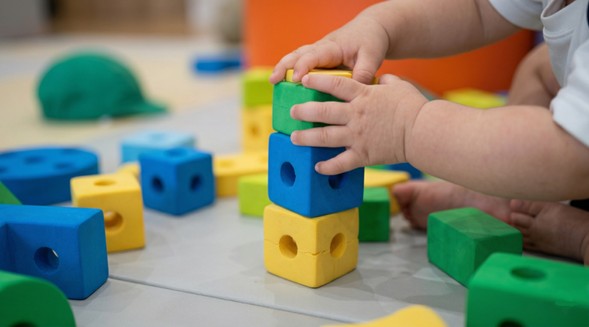
Baby playing with stacking blocks

Developmental Milestones: How Stacking Blocks Unlock Your Child’s Potential

In the modern learning environment, the simple act of a child reaching for a block is the first step in a lifelong journey of discovery. While it may look like mere games, block play is a rigorous workout for a child’s developing brain. At Bright Day Big Blocks, we believe that moving away from flimsy materials toward high-quality building blocks transforms a play area into a laboratory for growth. From the first “click” of a block to the complex building structures of a future engineer, these tools bridge the gap between simple curiosity and complex engineering.

By understanding Developmental Milestones, parents and educators can use stacking blocks to foster STEM growth, refine motor skills, and enhance social-emotional skills.

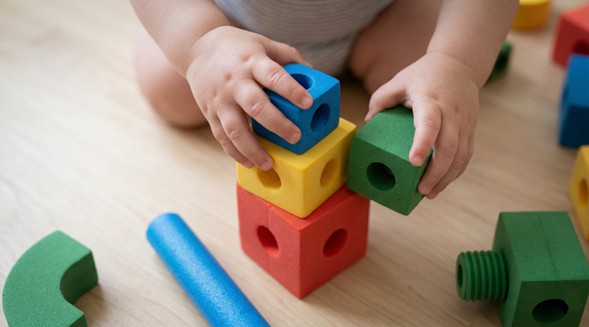
Child stacking blocks

Understanding Stacking Blocks Milestones

As children progress through various developmental stages, their interaction with blocks becomes more sophisticated. The stacking milestone is a key indicator of cognitive development and gross motor milestones.

The Path to Mastery:

  • Initial Discovery: Around 12 months, the focus is on handling skills and the sensorimotor development involved in grasping and releasing.
  • Vertical Alignment: By 15 to 18 months, children begin building a tower of two to three blocks, a feat that requires significant hand-eye coordination and motor planning.
  • Complex Construction: As they reach age two and three, they move from simple stacks to building bridges and creating visual-spatial relationships.
  • Symmetry and Patterns: Older preschoolers begin sorting shapes and exploring early math through symmetry and matching objects.

During these stages, children use Bright Day Big Blocks to master spatial reasoning and mathematics concepts. Whether they are performing stability testing or exploring numeracy skills by counting units, they are fostering STEM growth. Let’s take a closer look.

Stacking Toys for 1-Year-Olds: What are The Benefits?

At the one-year mark, a baby’s growth is characterized by rapid sensorimotor development. This is the stage where childhood development shifts from passive observation to active manipulation of the world. Introducing stacking toys during this period is crucial for mastering the pincer grip, allowing toddlers to pick up smaller loose parts and play cubes with precision.

For a one-year-old, block building is often about exploring visual-spatial relationships. They aren’t just building a tower; they are learning handling skills and investigating cause and effect. When they realize that letting go of a block makes it land on another, they are engaging in their first scientific skills.

Bright Day Big Blocks provide an exceptional tactile experience for the early childhood environment. The forgiving nature of our EVA foam ensures that when a wobbly tower eventually tips, it is a soft, silent event that encourages immediate rebuilding rather than frustration. By utilizing these lightweight foam cubes instead of heavy traditional materials, educators can foster an atmosphere of resilience and symbolic problem-solving, allowing the child to focus entirely on their emerging creative thinking and architectural discovery.

Stacking blocks for one-year olds

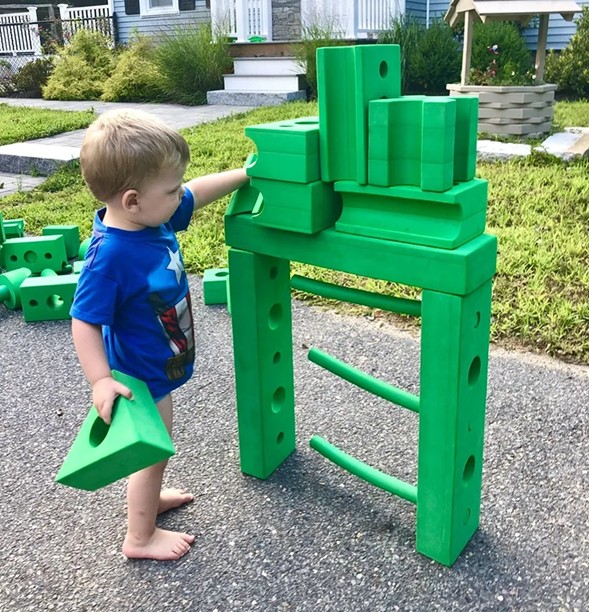
Stacking Toys for 18-Month-Olds: The Benefits Continue

By 18 months, a toddler’s problem-solving abilities and cognitive skills are flourishing. At this age, stacking toys should challenge their fine motor skills and encourage imaginative play. This is the perfect time to introduce nesting cups, stacking cubes, and larger building blocks that require two hands to lift, facilitating gross-motor development and body awareness.

At 18 months, children begin to engage in symbolic play and pretend play. A stack of blocks is no longer just foam; it becomes a house for toy cars, a station for toy trains, or a mountain for animal figures. This imaginative storytelling is vital for language development and general language skills, as children narrate their actions and describe their creations.

Stacking blocks for 18-months old

Promoting Advanced Skills:

  • Connection Schema: Children love the “click” of blocks connecting, which reinforces their understanding of how things fit together.
  • Spatial Awareness: Navigating a Block Play Area or a life-sized maze construction requires a “big picture” approach to building skills.
  • Social Interactions: Through cooperative play, toddlers learn the art of negotiation and social skills as they share blocks to build a cohesive town.

Beyond the Tower: A Holistic Approach to Play

The benefits of blocks extend far beyond the stacking milestone. According to the American Academy of Pediatrics, play is essential for emotional development and parent-baby bonding. By engaging in playful interactions, parents can create a profound learning environment.

In the modern classroom, educators can use toy rotation to keep the Block Play Area fresh. Try introducing loose parts like alphabet magnets or even pasta shapes to encourage different textures. You might even create a pillow pile for a soft landing zone during the “demolishing” phase of play.

Whether your child is demolishing the tower (a key lesson in physics concepts and physics) or using magnetic tiles to add flair to their foam cubes, they are developing symbolic problem solving skills that will last a lifetime.

Elevate Your Modern Classroom Today

Ready to help your child hit their next cognitive developmental milestone? Bright Day Big Blocks provide the safe, high-quality foundation needed for childhood development. From the pincer grip of a one-year-old to the spatial reasoning of a “Global Architect,” our blocks turn every moment of play into a moment of discovery.

Contact our team to know more, explore our catalog, and start to build your modern classroom today!
Digital Marketing by Nomadic Advertising