Let the Stacking Begin! Our Recommended Block Play Activities for Preschoolers
These activities are designed to be fun, educational, and easily adaptable to your preschool class.
1. The “Shadow Architect” Challenge
Concept: This fun activity challenges children’s spatial awareness and problem-solving skills by having them recreate shapes and structures based on shadows.
How to Play: On a sunny day, or using a strong flashlight in a dimmed room, create shadows of various shapes of blocks or simple block structures on a wall or the floor. Have children use Bright Day’s BIG Bright Block Kit blocks to build a structure that matches the perfect shadow. The kit’s distinct geometric shapes of blocks, like triangles and squares, make this a perfect matching game.
Learning Focus: Visual discrimination, spatial awareness, problem-solving, matching, and understanding light and shadow.
Teacher Tip: Start with single blocks, then move to two or three blocks stacked together. Encourage them to observe the shadow from different angles. This can be a quick breather activity or extended into a full exploration. Positive teacher-child interactions here can build confidence for more complex tasks.
2. The Collaborative Animal Habitat
Concept: Children work together to create an elaborate habitat for a dinosaur toy or their favorite animal, using a wide range of building blocks as construction materials.
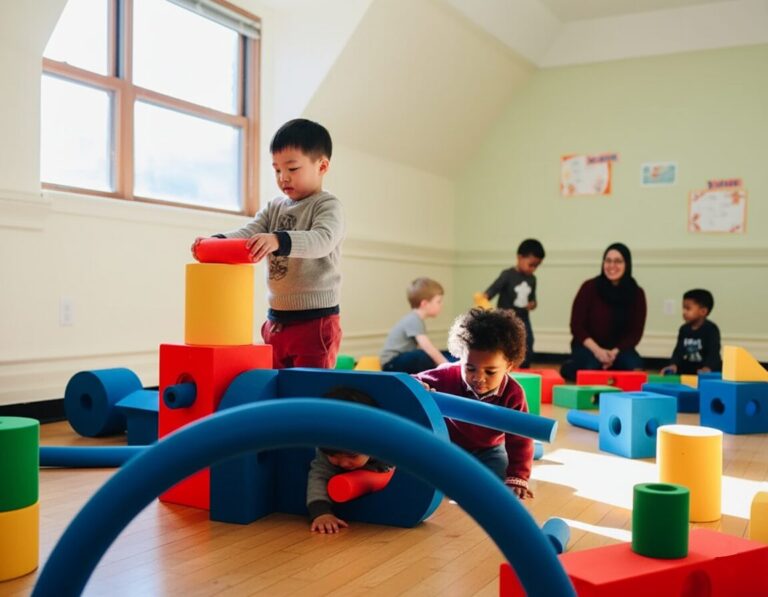
How to Play: Use the Animal Big Blocks set for the core structures. Ask the children, “What kind of home does an elephant need? What about a bird?” Then, using Bright Day’s “Animal Big Blocks” or “Big Green Blocks,” encourage them to build enclosures, caves, trees, and water features. The goal is to create a large, interconnected habitat.
Learning Focus: Collaboration, negotiation, imaginative play, understanding animal needs, and large-scale block play construction. Children practice building skills as they divide the space and decide what goes where.
Teacher Tip: Facilitate discussions about different biomes and what animals need to survive. Provide a variety of shapes of blocks and even some natural elements like leaves or twigs (if safe and clean) to enhance the realism. This activity can be revisited a couple of times, with different animals each time.
3. “The Great Bridge Build” Engineering Challenge
Concept: This block-building activity focuses on stability, balance, and problem-solving as children design and build bridges strong enough to hold small toys.
How to Play: Set up two “riverbanks” using low tables or designated areas on the floor. Provide a variety of different options, including interlocking blocks and flat pieces. Challenge the preschoolers to build a bridge across the “river” that can support a small car or dinosaur toy.
Learning Focus: Early engineering concepts, understanding weight distribution, balance, process of trial and error, and critical thinking. They will learn that simply stacking blocks doesn’t always create a strong structure.
Teacher Tip: Discuss different types of bridges they’ve seen. Encourage them to test their bridges and revise their designs if they collapse. Celebrate both successful and “collapsed” bridges as learning opportunities. You might even introduce simple building guidelines like “the bridge must be wide enough for two cars.”
4. Rainbow Maze for Color Exploration
Concept: Using Bright Day’s “BIG Bright Block Kit,” children build a maze where each section corresponds to a specific color, encouraging color recognition and spatial reasoning.
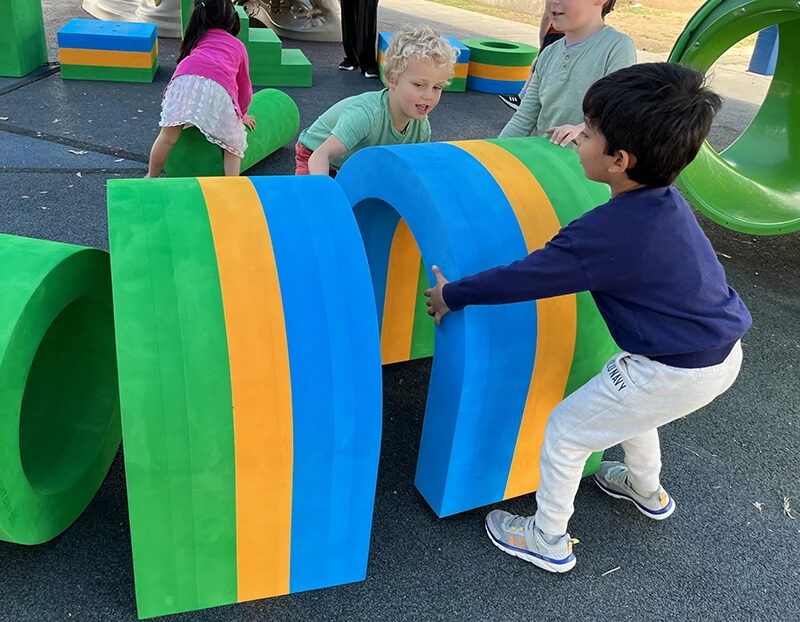
How to Play: Assign small groups of children a color (e.g., “Team Green,” “Team Blue”). Each team is responsible for building a section of a large maze using only their assigned colored blocks. They can create tunnels, walls, and doorways. Once built, children navigate the maze, following color cues like “only walk through yellow rooms” or “find the green treasure zone.”
Learning Focus: Color recognition, teamwork, communication, spatial awareness, and gross motor skills as they move through the maze. This is an enormous fun way to incorporate block play with educational directives.
Teacher Tip: Use painter’s tape to mark out the general path of the maze initially, or let the children design it freely. Incorporate specific tasks within the maze, like finding a hidden object in the “blue castle.”
5. Obstacle Course Arena with Foam Shapes
Concept: Transform a play space into an active obstacle course using Bright Day’s foam stairs, arches, and ROCK+ROLLER pieces, encouraging physical activity and creative problem-solving.
How to Play: Provide a wide array of Bright Day’s diverse shapes of blocks. Encourage children to design and build an obstacle course, featuring tunnels to crawl through, stairs to climb, arches to duck under, and the ROCK+ROLLER for balancing or spinning. They can work individually or in teams to create the ultimate challenge.
Learning Focus: Gross motor skills, balance, coordination, following directions, and creative design. This fun activity allows children to practice building skills while staying active.
Teacher Tip: Guide children to think about different movements: crawling, climbing, jumping, and balancing. Create simple “rules” for navigating the course (e.g., “you must go over the green tower,” “crawl under the green arch”). This makes for excellent teacher-child interactions as you cheer them on and help them problem-solve.